FOR ACADEMIC & CULTURAL ENRICHMENT
FOR ACADEMIC & CULTURAL ENRICHMENT
FOR ACADEMIC & CULTURAL ENRICHMENT
FOR ACADEMIC & CULTURAL ENRICHMENT
FOR ACADEMIC & CULTURAL ENRICHMENT
FOR ACADEMIC & CULTURAL ENRICHMENT
FOR ACADEMIC & CULTURAL ENRICHMENT
FOR ACADEMIC & CULTURAL ENRICHMENT


for Academic & Cultural Enrichment
for Academic & Cultural Enrichment

for Academic & Cultural Enrichment
Contact


_edited.jpg)


FINANCIAL RESOURCES
Click HERE for additional Scholarships & Grants
Grants for 2026
Grants are a form of financial aid that you do not have to repay. Eligibility is primarily based on financial need, determined by the Free Application for Federal Student Aid (FAFSA®). The 2026–27 FAFSA form is now available for the award year spanning July 1, 2026, to June 30, 2027.
Federal grants
-
Federal Pell Grant: The largest federal grant program for undergraduate students with exceptional financial need. For the 2026–27 school year, the maximum award is based on your financial need and other factors.
-
Federal Supplemental Educational Opportunity Grant (FSEOG): An additional grant for undergraduates with the highest financial need. It is awarded on a first-come, first-served basis, so apply early.
-
Teacher Education Assistance for College and Higher Education (TEACH) Grant: For students committed to teaching in a high-need field at a low-income school for at least four years after graduation.
State grants
-
Many states offer their own need-based or merit-based grant programs for residents attending in-state colleges. Check with your state's higher education agency for specific options. For example, the California Student Aid Commission offers the Cal Grant for California students.
Scholarships for 2026
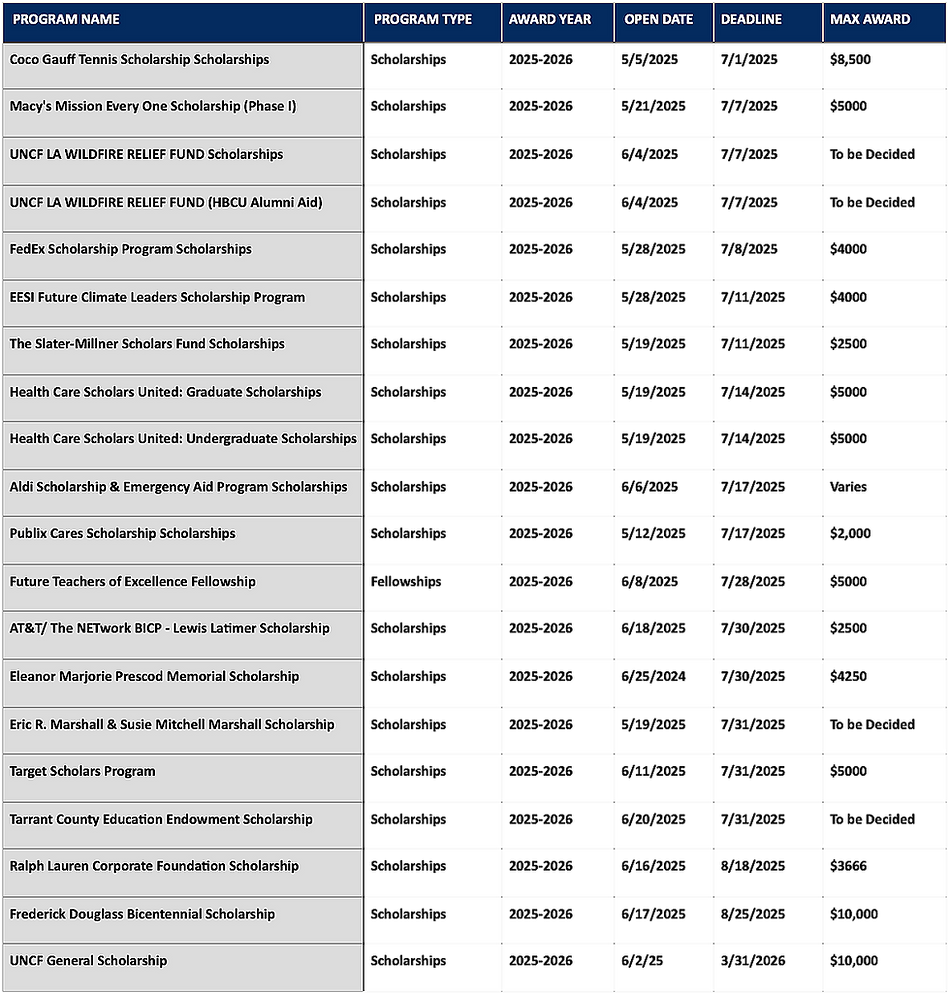
Scholarships are merit-based and do not need to be repaid. They are awarded based on various criteria, such as academic achievement, talents, interests, and background. The best time to start applying is as early as your junior year of high school.
Scholarship databases and search engines
-
Fastweb: Matches your profile with a vast database of scholarships, internships, and colleges.
-
College Board's BigFuture: Offers a comprehensive scholarship search tool with over 2,200 programs.
-
Niche: Known for school reviews, but also offers a robust scholarship search feature.
-
Bold.org: A platform where you can apply for scholarships, many of which have no essay requirements.
-
CareerOneStop: A free search tool sponsored by the U.S. Department of Labor.
-
Scholarship America: A national organization that administers various scholarship programs.
Corporate and foundation scholarships
-
The Gates Scholarship: For high-achieving, low-income students who are members of certain minority groups.
-
Coca-Cola Scholars Program: A $20,000 scholarship for high-school students with a focus on leadership and community.
-
Dell Scholars Program: For high-school students with academic potential and a documented need for financial assistance.
-
Jack Kent Cooke Foundation: Provides a highly selective transfer scholarship program for top community college students.
-
Burger King Scholars Program: Awarded to high-school students based on their academic record and community involvement.
Regular admission deadlines for college applications typically fall in January, with January 1 being a very common date, though some are in early February or later. Students who apply by regular decision can expect to receive admission decisions in March or April and have until May 1 to enroll.
Typical regular decision deadlines and timelines
-
Application deadline: Most common deadlines are around January 1 or January 15.
-
Decision notification: Decisions are usually sent out in March or April.
-
Enrollment deadline: The national deadline for accepting an offer of admission is May 1.
Variations and exceptions
-
Some schools have later deadlines, extending into February, March, or even later.
-
The University of California (UC) system has a different, earlier deadline of November 30 for regular decision.
-
It is crucial to check each college's specific deadline, as they can vary even for the same application type.
What to keep in mind
-
Preparation is key:
Start gathering materials like recommendation letters, essays, and test scores well in advance, as they take time to prepare.
-
Most common option:
Regular decision is the most popular application type because it gives students more time to complete their applications and compare offers from multiple schools.
Easy or no-essay scholarships
-
Appily Easy Money Scholarship: A simple monthly scholarship drawing for U.S. high school students.
-
$2,000 Sallie Mae No Essay Scholarship: A monthly drawing for $2,000.
How to maximize your financial aid for 2026
-
Complete the FAFSA: Submit the FAFSA as early as possible after it opens in October 2025. This is the first step for federal, state, and many institutional and private aid programs.
-
Start your search early: Begin researching scholarships during your junior year of high school or earlier to get a head start on gathering materials and meeting deadlines.
-
Look locally: Explore local scholarships offered by community foundations, businesses, and religious or civic organizations. These often have fewer applicants.
-
Check with specific colleges: Review the websites of the colleges you are applying to. They often have their own internal grants and scholarship programs.
-
Talk to your high school counselor: They can provide personalized guidance and local scholarship opportunities.